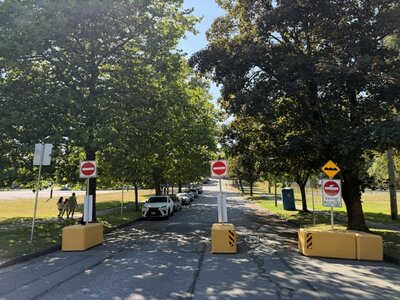
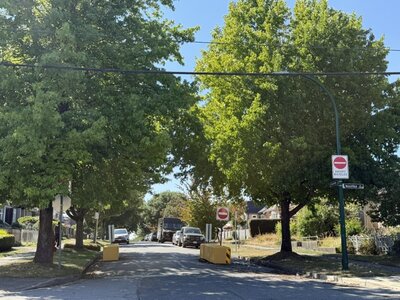
Every stop leaves something behind - and not just the frustrated sighs of East Vancouver drivers trying to navigate traffic calming measures. Frequent decelerations (as required by barricades, diverters, and speed humps) release particles from the brake pads and rotors, which are then distributed across the area by both wind and vehicle movement. These containments are microscopic, but they can have long-lasting effects.
A review of brake-wear research found that particles can account for 16–55% of non-exhaust PM10 in urban environments, compared with roughly 3% on highways (where decelerating is less frequent). The same review notes that the highest brake-wear concentrations are commonly observed near busy junctions, pedestrian crossings, and corners. Traffic calming measures increase overall containment ratings.
Real-world testing found brake PM2.5 concentrations during major events reaching 520–4,280 µg/m³, while PM10 rose to 950–8,420 µg/m³. The study found that braking deceleration was a statistically significant predictor of particle concentrations; and, more recently, research at urban intersections found brake-wear emissions peaking at 14 times higher than tailpipe exhaust, with local PM concentrations of up to 34.5 µg/m³. These particles can then accumulate in the nearby environment - with higher outputs of zinc, antimony, and other metals increasing groundwater toxicity and undermining soil balance.
Traffic calming - over time - can impact more than driver patience. It can instead create contaminated hot-spots... right in our neighbourhood.
Sources
Brake wear particle emissions
Brake and tire particles measured from on-road vehicles
Comparative assessment of real-world vehicle particulate emissions
Spatial distribution of traffic-emitted heavy metals in urban road dust
Traffic Calming Effects In East Vancouver
More Stops, More Contaminants: Traffic Calming In East Vancouver
.png)