
Residents across East Vancouver have raised concerns about emergency vehicles reaching their streets. Those concerns are usually treated as anecdotal. They are not. The City of Vancouver identified the same problem in its own budget document — and residents raised it in a City report more than twenty years ago.
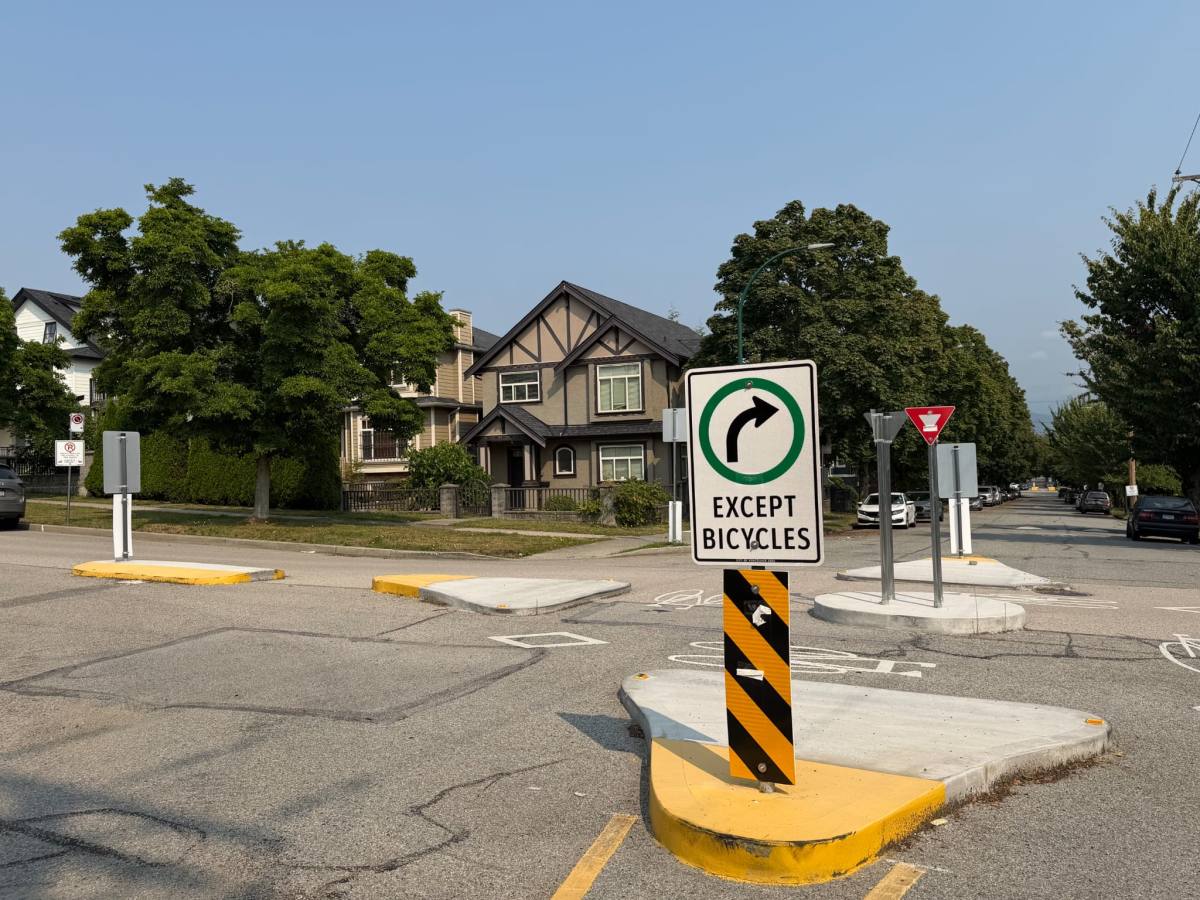
Between 1st Avenue and Hastings Street, from Nanaimo to Boundary, a series of traffic-calming projects has reshaped how people move through their own neighbourhood. Streets that ran through now stop. Turns that were routine are prohibited. Routes home have become longer and less obvious.
Residents have raised many concerns about these changes. This article addresses one of them, because it is the one where the public record is clearest: what happens when an emergency vehicle needs to reach an address on a calmed street.
We are going to be careful about what the evidence supports. Some of what follows is the City stating something in its own document. Some of it is residents' accounts that the City recorded but did not independently verify. Those are different things, and we will say which is which every time.
What the City said in its own budget
The City of Vancouver's 2017 Budget, published in December 2016, contains service plans for each department. Under the section covering Fire Suppression and Special Teams, the City writes:
"VFRS is experiencing a slight increase in response times to fires due to increasing traffic congestion and traffic-calming initiatives. The percentage of fires confined to the area of origin has been decreasing over the last five years, partially due to increased response times."
City of Vancouver, 2017 Budget, Part II: Department Service Plans, page 176
This is not a resident's complaint. It is the City describing its own fire service and naming traffic-calming initiatives as one of the contributing causes.
The same page publishes Vancouver Fire and Rescue Services' response times at the 90th percentile — the time within which nine of every ten calls were reached:
| Year | Response time (90th percentile) | Structure fires confined to area of origin |
|---|---|---|
| 2012 | 6:08 | 24% |
| 2013 | 6:14 | 21% |
| 2014 | 6:25 | 19% |
| 2015 | 6:28 | 17% |
| 2016 (forecast) | 6:35 | 19% |
Twenty-seven seconds slower over five years. Taken alone, a small number. Read alongside the second column, it is harder to dismiss: over the same period the share of structure fires contained to where they started fell from roughly a quarter to under a fifth, and the City connects that decline directly to slower arrival.
Further down the same page, under "Medical calls," the City writes that its medical response-time metric "is seeing an increase due to multiple factors, which include traffic congestion and traffic-calming initiatives."
Fire and medical, both, in the City's own words.
East Pender Street, 2004
Twenty-two years ago, residents in this part of the city raised the same concern, and the City wrote it down.
In July 2004, City staff produced an administrative report titled 1900 Pender Street Traffic Calming Plan – Follow-Up, authored by Fred Lin, P.Eng., of the Neighbourhood Transportation Branch, reference RTS 04333. It went to the Transportation and Traffic Committee on September 14, 2004.
In Appendix C of that report — the section reproducing residents' survey comments — two accounts appear.
One described an ambulance having difficulty entering the 2000 block of Ferndale Street, with emergency personnel parking at Ferndale and Semlin and continuing on foot carrying first-aid equipment.
The other described a Vancouver Fire rescue vehicle responding to a report of chest pains at 2164 East Pender. According to the account, the vehicle could not make the eastbound turn onto East Pender because of its size, and instead travelled north on Victoria, east on Hastings, south on Templeton, and back to the 2100 block of East Pender.
What happened next
The Transportation and Traffic Committee considered the report, including questions about input from fire and ambulance services in the proposed designs. The Committee unanimously recommended that the traffic-calming measures be retained permanently, and Council approved that recommendation.
We are not arguing that decision was wrong. We were not in the room, and the report contained a great deal more than those two accounts.
What we observe is the shape of it. A specific and serious concern was raised, recorded, discussed — and the outcome did not change. Being heard and being answered are not the same thing.
Why the two documents matter together
On their own, each is limited. The 2004 accounts are unverified resident reports. The 2017 budget statement is citywide and hedged.
Together they describe something more specific. Residents identified a mechanism in 2004 — that the physical configuration of calmed streets can prevent emergency vehicles taking the direct route. Twelve years later, the City itself named that mechanism as a contributor to rising fire and medical response times.
The residents were describing something real. The City later agreed it was real.
What has not been published, as far as we have been able to establish, is any assessment of what that means for the specific projects installed across East Vancouver since 2020.
What we are asking for
We want the city of Vancouver to “ Remove the Barriers” and restore the neighborhood to what it was before, with no travel restrictions.
This means, specifically:
1) remove the barriers and full road closures to vehicles.
2) remove the one way streets and restore them to two way roads for vehicles
3) remove all right turn only barriers
4) remove the concrete blocks on all the roads from 1st Ave to Hastings Street and Boundary Rd to Nanaimo.
5) implement an immediate moratorium on any future barriers, road closures, traffic calming and slow street initiatives.
6) Implement a referendum and require public consultation for any future traffic calming and slow streets initiatives and require majority vote before proceeding with any future transportation projects.
Questions and answers
Is Remove The Barriers against bike lanes?
No. This is about how decisions get made, not about who uses the road. Our four asks — notice, published data, displacement measurement, and a working review process — would apply equally to any permanent change to a residential street, whatever it was for.
People in this group hold a range of views about cycling infrastructure. What we agree on is that residents should be consulted before permanent changes, and that the City should publish what it knows.
Doesn't traffic calming make streets safer?
Slower vehicle speeds on a treated street generally do reduce the severity of collisions there. That is well established and we are not disputing it.
The question is what happens across a connected area rather than on one block. When traffic is diverted rather than removed, it goes somewhere — often onto adjacent streets, back lanes, or routes near schools. Whether the net effect across a neighbourhood is safer depends on measuring where it went. That measurement is what we are asking for.
Did the City consult residents before making these changes?
The City runs consultation processes, and it will point to open houses, surveys and mail-outs. We are not claiming no process existed.
What residents in this area report is that they did not hear about changes until they appeared, that concerns raised afterward received a case number and a form reply, and that nothing changed as a result. The 2004 report shows a version of this: concerns recorded, discussed, and the measures retained.
If the City has consultation records for the projects in our area, publishing them would settle the question. We would genuinely like to see them.
Has traffic calming actually delayed an emergency in East Vancouver?
We cannot say that with the evidence currently available, and we are not going to claim it.
What we can say: two residents described emergency-access problems in a 2004 City report; the City stated in its 2017 budget that traffic-calming initiatives were contributing to rising fire and medical response times citywide; and the City has not published response-time data specific to East Vancouver's calmed streets.
That last gap is why we are pursuing the records request set out below. The data exists in dispatch systems. It has simply not been made public.
Why does it matter where the traffic goes?
Because a project that moves traffic rather than reducing it has not solved anything — it has relocated the problem onto a street whose residents were never consulted, and often onto back lanes that were never designed to carry through traffic.
Residents in this area have counted substantial volumes of vehicles using back lanes during periods when nearby streets were closed. If the City is measuring only the treated street, the reported result will look like a success while the neighbourhood experiences the opposite.
Can any of this actually be changed?
Yes. These are policy decisions made by an elected council, recorded in public staff reports and approved by public vote. What a council installs, a council can review.
Correspondence to Mayor and Council becomes part of the City's official communications. Residents can also request to speak at committee meetings and public hearings. Both are more effective than a social media post, and both create a record.
The records we are requesting
The City holds data that would answer most of the open questions here. It has not been published, so we are requesting it. We will publish what comes back, whatever it shows.
- Emergency response times by address or intersection within the East Vancouver traffic-calming areas, before and after each project.
- The number of emergency calls in these areas requiring a detour from the normal route.
- Any incidents where an emergency vehicle was unable to use its intended route, or had to stop, reverse, turn around, or approach on foot.
- Correspondence between the City and Vancouver Fire and Rescue Services regarding emergency access to the 1900–2100 blocks of East Pender, Ferndale and Lakewood.
- Any emergency-access risk assessments or emergency-service sign-offs prepared for East Vancouver traffic-calming projects since 2020.
- Traffic counts before and after each project, including counts on adjacent streets and back lanes.
- Project costs, broken down by neighbourhood and by installation type.
- Records of resident consultation for each project, including what notice was given, to which addresses, and on what date.
If these assessments exist and are sound, publishing them ends the argument and we will say so plainly. If they do not exist, residents are entitled to know that too.
- City of Vancouver, 2017 Budget, Part II: Department Service Plans, page 176. Published December 2016.
- City of Vancouver, Administrative Report, 1900 Pender Street Traffic Calming Plan – Follow-Up, July 17, 2004. Fred Lin, P.Eng., Neighbourhood Transportation Branch. RTS No. 04333, CC File No. 5757.
- City of Vancouver, Transportation and Traffic Committee minutes, September 14, 2004.
Quotations from the 2017 Budget have been checked against the source document. The emergency-vehicle accounts from the 2004 report appear in Appendix C of that report as resident survey comments and are presented here as such.