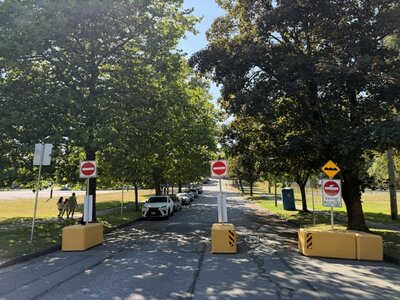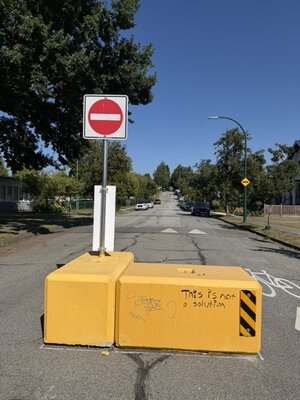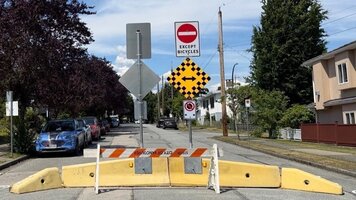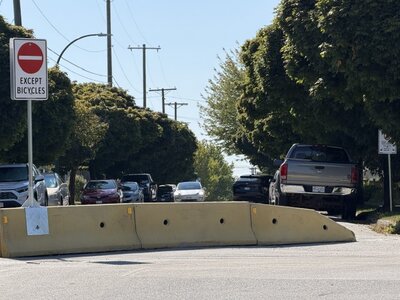
Speed reduction is the oft-touted virtue of traffic calming. What happens, however, when vehicles are exposed to repeated braking, accelerations, and new turns?
The answer is tire pollution - bringing microplastics and emissions to East Vancouver.
A 2020 study found that tire-wear particle emissions are influenced by acceleration forces, earning an output of 3.7 mg per vehicle-kilometre. From that amount, 3.3% of tread wear appeared as PM2.5 and 3.7% as PM10, with lateral movement increasing results. Meanwhile, a 2024 study measured 1.27 mg/km of tire-wear PM10 and 0.21 mg/km of tire-wear PM2.5; while brake wear produced substantially more: 11.65 mg/km of PM10 and 2.66 mg/km of PM2.5.
These numbers represent particles released into the air by constant applied pressure - such as from having to brake at traffic calming barricades or turn down a new route. The emissions (consisting of dust and rubber) can greatly impact the environment over time, creating outputs higher than exhaust fumes. They contaminate both air and land, with researchers finding copper and zinc concentrations four times higher in areas with speed humps and similar measures. This is enough to raise concerns over potential health risks for those consistently exposed.
Traffic calming reduces speeds - and increases emissions. Our community is left to deal with the aftermath.
Sources
Transportation Research Part D — Field evaluation of traffic-calming environmental impacts.
Environmental Science & Technology — Tire-wear particle measurements.
Science of the Total Environment — Real-world brake and tire-wear measurements.