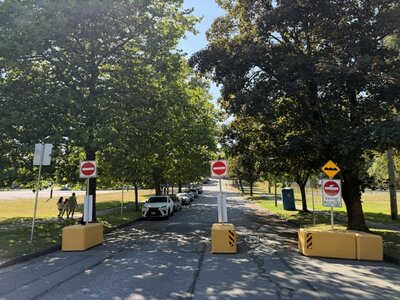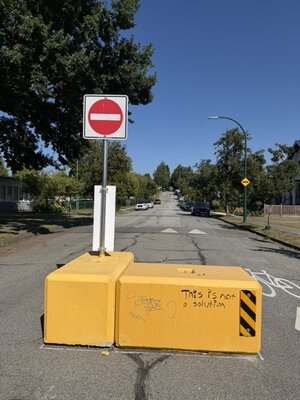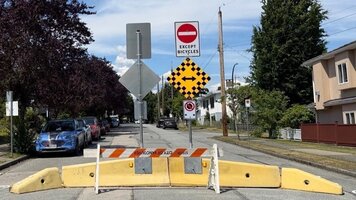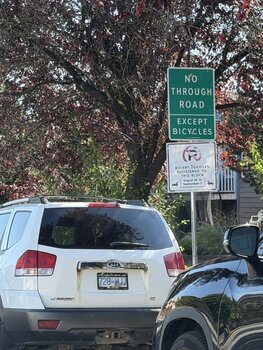
The displaced cars didn't simply disappear when the barricade arrived, however. They turned, detoured, circled the block, and added countless kilometres to their journeys—at a considerable environmental cost.
Where Does the Traffic Go In East Vancouver?
Metro Vancouver uses vehicle kilometres travelled (VKT) as a transportation-performance measure, linking reductions in driving distance with lower greenhouse-gas emissions and congestion. That makes the environmental impact of traffic calming worth examining more closely: while a full closure may reduce volumes on one street, it can also force drivers onto longer routes, potentially increasing the total distance travelled elsewhere. The question, therefore, is not simply how much traffic a project removes from a particular block, but whether it actually reduces overall kilometres.
The issue becomes even more complicated as navigation apps increasingly influence how drivers respond to road closures and changing traffic conditions. A 2024 study found that widespread use of GPS recommendations can reduce the diversity of routes drivers take, concentrating traffic—and potentially emissions—onto a smaller number of roads. Overall CO? outputs rise.
Research on traffic-calming treatments also suggests that emission effects are far from straightforward. A New Zealand Transport Agency literature review found that several studies recorded increases in CO? emissions following the use of diverters, barricades, and similar methods, with one particularly striking result involving speed tables in a 30-km/h zone. In that experiment levels increased by 107%.
The lesson for East Vancouver is straightforward: don't measure the traffic that disappears when a road is closed. Instead examine the potential environmental cost.
Sources
Metro Vancouver — Vehicle Kilometres Travelled
Cornacchia et al. — Navigation services amplify concentration of traffic and emissions
New Zealand Transport Agency - Emission studies.