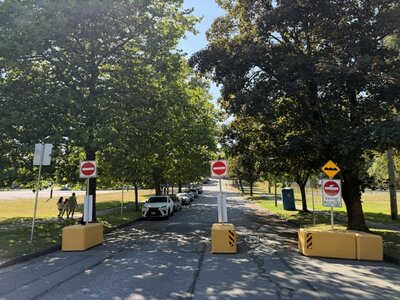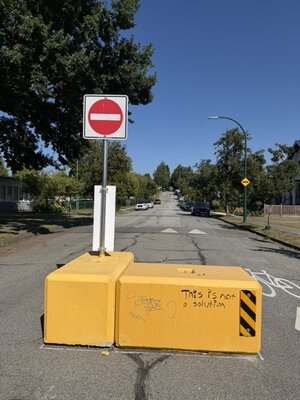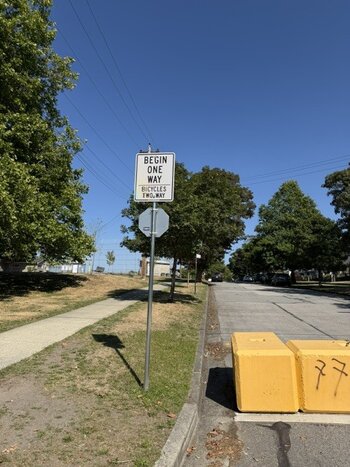
For residents living beyond the barrier, however, an unintended consequence is gained - a longer commute.
The Commuting Concern In East Vancouver
Imagine that a full closure adds just five minutes each way to a resident's daily trip. This time, at first, seems insignificant, with little attention paid to the extra seconds. However, it quickly begins to accumulate.
10 additional minutes per weekday.
50 additional minutes per week.
42 additional hours per year.
50 additional minutes per week.
42 additional hours per year.
Suddenly, the simple traffic diversion is spiraling into a complicated problem - one that will cost drivers more than time.
The B.C. Ministry of Transportation and Infrastructure assigns a dollar value to travel time when evaluating transportation projects. Its published benchmark for auto occupants was $18.49 per person-hour, based on 50% of the median household hourly income.
Using that benchmark, our modest five-minute detour suddenly demands significant costs - with its 42 accumulated hours representing approximately $770 in lost time annually.
It is, of course, important to note that the B.C. calculation does not mean that every driver loses $18.49 in wages with each diversion. It is an economic valuation used to compare transportation costs and benefits. However, it provides a useful way to demonstrate that additional travel time is not economically free. The costs will collect and grow throughout the year, leaving East Vancouver commuters to pay the toll.
Full closure traffic calming delivers sustained economic concerns - with commutes lengthened and expenses raised. With each barrier comes a high price.
Sources
B.C. Ministry of Transportation and Infrastructure — Transportation Planning Benefit-Cost Analysis
B.C. Ministry of Transportation — Default Values for Benefit Cost Analysis
Statistics Canada — Canadian commuting statistics
.png)