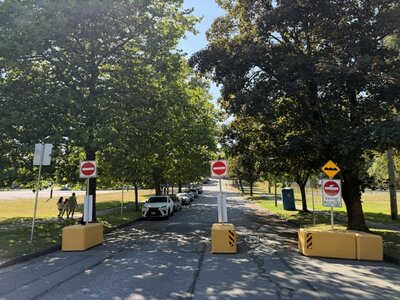
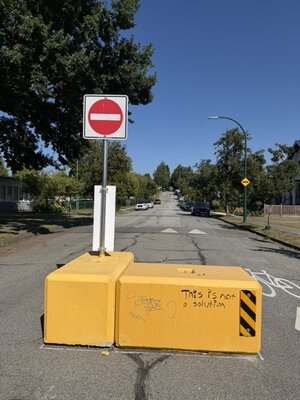
All traffic calming measures are not created equally. The promise of full-closure safety is too often undermined by the reality of diverted risks - and one question continually looms over every barrier, divider, and median.
Has the neighborhood actually become safer…. or have the issues simply moved around the corner?
When the Risk Moves With the Traffic in East Vancouver
Safety truly is just a number. According to a Danish study by Engel and Thomsen, traffic-calming measures (including speed humps and staggered roadways) reported a 72% reduction in injury rates within their designated areas, with overall motor incidents and pedestrian accidents decreasing. This statistic, at quick glance, proves promising. However, the same research found that injury rates increased by 96% on adjoining streets - with driver performance plummeting. The risks didn't disappear. They just shifted to new areas and gained equally new consequences.
More recent research continues to emphasize this concern. A 2026 systematic review of traffic-calming identified hazardous route diversions as a potential side-effect that should be considered when assessing projects - leading to an increase in vehicle incidents and creating a less safe environment for those outside of the enclosure. Improving the conditions of one road will often negatively impact others, undermining the entire purpose of full-closure barriers.
Traffic calming extends far beyond mere speed reduction. It instead shifts patterns to neighborhoods that may be ill-equipped to accommodate them - seeing those high incident statistics simply migrate beyond the barricade.
Sources
Federal Highway Administration — Synthesis of Safety Research Related to Speed and Speed Management. Summarizes research on traffic calming, including evidence concerning traffic diversion and safety effects on adjoining streets. FHWA — Synthesis of Safety Research Related to Speed and Speed Management
Elvik (2001) — “Area-wide urban traffic calming schemes: a meta-analysis of safety effects.” Meta-analysis of 33 studies examining the safety effects of area-wide traffic-calming schemes. Elvik — Area-wide urban traffic calming schemes
Bajestani & Pirdavani (2026) — “Traffic Calming Measures in Urban Environment: A Systematic Review.” Recent systematic review examining the effects and potential unintended consequences of traffic-calming measures. Traffic Calming Measures in Urban Environment: A Systematic Review
Magkafas et al. (2025) — “Beyond Speed Reduction: A Systematic Literature Review.” Review emphasizing that traffic-calming interventions should be assessed using multiple safety and mobility outcomes rather than speed reduction alone. Beyond Speed Reduction: A Systematic Literature Review
Traffic Calming Effects In East Vancouver
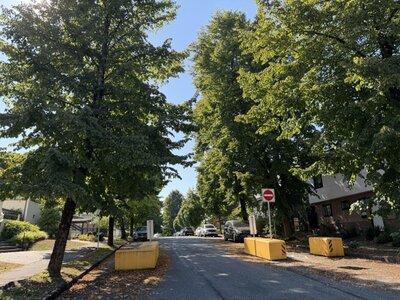
Shifting Patterns in East Vancouver: The Traffic Calming Conundrum
.png)