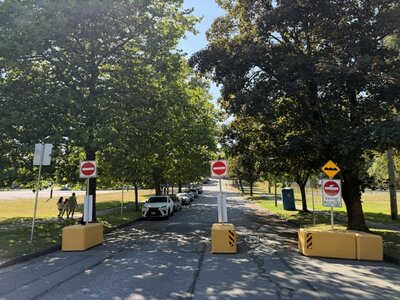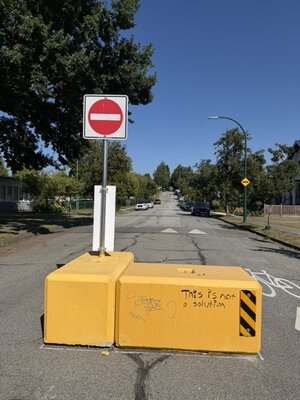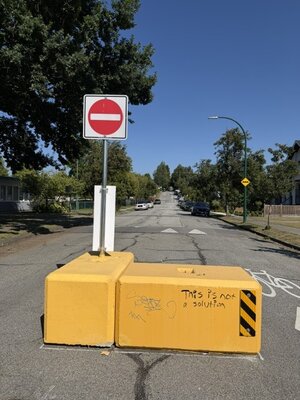
It also brings stress.
Examining the Effects of Traffic Calming in East Vancouver
Traffic calming emphasizes safety through restrictions, trying to funnel traffic through a series of barriers and blockades. However, with every obstacle placed, it can leave drivers overwhelmed and underprepared.
A 2013 study in Accident Analysis & Prevention observed the effects of traffic closure measures on cognitive load (the mental strain experienced while completed tasks). Researchers put 46 drivers through a 34-kilometre simulated route containing different combinations of horizontal curves and gate treatments. The curves produced sustained reductions in speed, but they also increased extreme variability in acceleration and deceleration, as well as lateral vehicle position. A peripheral-detection test indicated these conditions caused high-stress reactions.
Similarly, the 2013 experiment found that gate treatments produced smaller, more localized effects around road entrances; and more recent simulator research earned the same results. A 2025 study involving 54 participants found that physical barriers reduced speeds but also produced more abrupt decelerations (leading to considerable driver stress and impacted cognitive performance).
Traffic Calming Delivers Stress, Rather Than Safety, in East Vancouver
The potential consequences become clearer when roadway complexity is combined with an already demanding driving situation. A 2026 study involving 1,240 participants examined high cognitive load and acute stress in simulated scenarios, and the resulting decrease in performance was of considerable concern. Reactions, and judgments, were noticeably impaired; and these non-optimal states impacted both lane-keeping and vehicle control. Erecting barriers did not produce a safer environment. It instead caused a heightened chance of dangerous responses.
Traffic calming promises more efficient travel experiences - but, when implemented incorrectly, it can lead to situations far more stressful than the afternoon rush.
Sources
Ariën, C. et al. (2013), A simulator study on the impact of traffic calming measures in urban areas on driving behavior and workload, Accident Analysis & Prevention. PubMed — 2013 study
Pirdavani, A. et al. (2025), A Driving Simulator-Based Assessment of Traffic Calming Measures at High-to-Low Speed Transition Zones, Smart Cities. Full article — MDPI
Bakhchina, A.V. et al. (2026), The dynamics of driving performance in non-optimal human states: Drowsiness, high cognitive load, and acute stress, Traffic Injury Prevention. PubMed — 2026 study
Federal Highway Administration, Traffic Calming ePrimer. FHWA Traffic Calming ePrimer
Federal Highway Administration, Calming Measures: Traffic Calming. FHWA Traffic Calming Measures
.png)