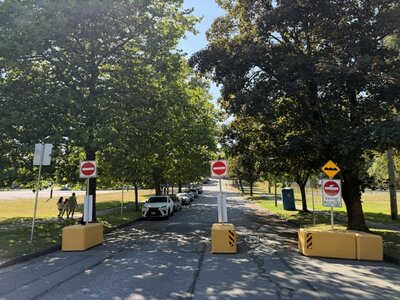
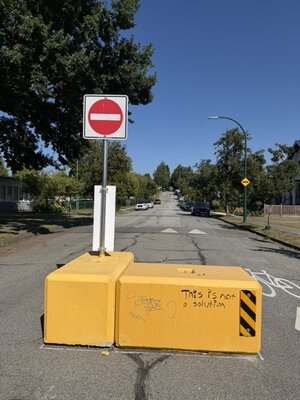
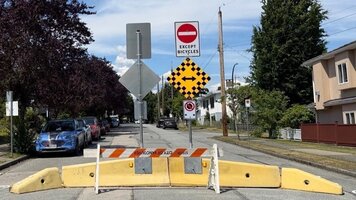
If you live between Nanaimo and Boundary, somewhere between 1st Avenue and Hastings, you have watched your neighbourhood change. Streets that used to run through now stop. Turns you made for years are no longer legal. Getting home takes a route you would not have chosen.
The City calls this traffic calming. It is worth understanding what that term covers, because the label describes an intention, not an outcome.
The toolkit
Traffic calming is a set of physical changes to streets, meant to slow vehicles down or discourage drivers from cutting through residential areas. The common tools:
Speed humps — raised sections of pavement that make drivers slow down to cross comfortably.
Traffic circles — small roundabouts at residential intersections, which slow turning movements and remove the need for stop signs.
Diverters — barriers that physically prevent certain movements, forcing traffic to turn where it once continued straight.
Full closures — a street blocked entirely to through traffic.
Curb extensions — the sidewalk pushed out at corners, shortening the crossing distance for people on foot.
Flexible delineators and bollards — the posts that narrow a lane or protect a cycling space.
Each of these does something specific. Used carefully, in the right place, they work. The question in East Vancouver is not whether any single device is reasonable. It is what happens when many of them are installed across a connected area at once.
One change, or many
A speed hump on one block is a modest thing. A diverter here, a circle there, a closure two streets over, and the picture changes. Traffic does not disappear when a route closes. It goes somewhere else.
That somewhere else is often the next street. Or the back lane. Or a route past a school.
This is the part residents notice first and reports discuss least. When the City measures a traffic-calming project, it typically measures the treated street — and the treated street usually does get quieter. What is harder to find is the measurement of where the traffic went.
These are political decisions, and they are reversible
It is easy to experience street changes as something that simply happens, like weather. They are not. Every barrier, closure and diverter is the result of a decision by elected officials, made in public, recorded in a staff report, and voted on at a council meeting.
That matters for two reasons.
First, decisions made by councils can be reviewed by councils. Infrastructure that was installed can be modified or removed. Road configuration is a policy choice, not a permanent fact.
Second, decisions made in public can be examined in public. Council agendas, staff reports and traffic data are published. We read them, and we will show our neighbours where to look.
What we are asking for
Remove The Barriers is not opposed to safer streets. We are residents who want the decisions about our streets made with us rather than around us.
Specifically:
- Notice before installation, not after. People who live on an affected street should hear about a permanent change before it is built.
- Published data, broken down by neighbourhood. What was installed, where, what it cost, and what the traffic counts showed before and after.
- Measurement of displacement. Not just whether the treated street got quieter, but where the traffic went — including back lanes and streets near schools.
- A review process that works. A way for residents to raise a problem and get a substantive answer, rather than a case number and a form reply.
None of that requires anyone to agree about cycling, or cars, or what a street is for. It requires the City to show its work.
Next in this series
Over the coming weeks we will look at what the City's own documents say about emergency vehicle access, what happened when residents raised concerns on East Pender Street two decades ago, and where the traffic goes when a street closes.
If you live in the area and have something to add — a route that changed, a count you have taken, a reply you received from the City — we want to hear it.